Body massage · 8 min
What is cupping massage? Treatment, marks and your first visit
A cup against the skin works differently from a hand pressing into a muscle. Cupping uses suction and can form part of work with tense areas of the back, neck, shoulders or legs. Here is what the treatment feels like, why marks can appear and how to choose between cupping and other types of massage.

What is cupping massage?
Cupping massage uses cups to create negative pressure against the skin. The skin lifts into the cup, producing a pulling sensation rather than the downward pressure of conventional massage. How noticeable that pull feels depends on the suction and the area being treated.
In body cupping, cups are placed on a selected area. The level of suction and the area treated both affect how it feels.
You may also see the term cupping therapy. These names do not always describe identical practices. It is worth checking what a particular clinic offers rather than assuming that every photograph or video shows the same procedure.
Source: [1]
How does suction compare with hands-on massage?
During ordinary massage, you feel strokes, pressure and movement through the tissues. A cup applies a different type of contact. People may describe it as a local pull or a feeling of tightness in the skin. You should still be able to breathe freely and settle into the treatment.
You and your practitioner agree on pressure and areas of focus. If you are tensing your body to tolerate the sensation, that is a useful signal to change the approach. A tight area does not automatically need the strongest possible suction.
Cups can be used in different ways. We choose the approach according to the agreed area and your response. You do not need to decide between every named technique in the booking form. It helps more to explain what you are looking for and how you have responded to previous treatments.
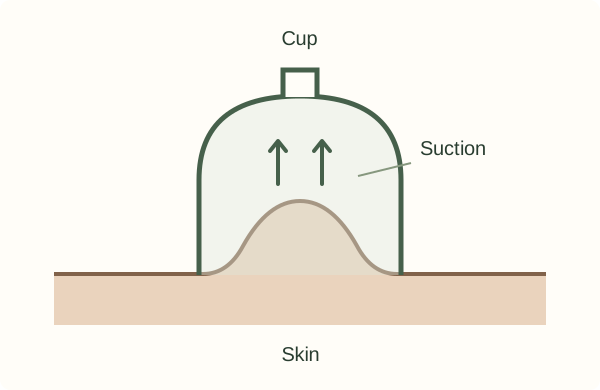
The cup lifts the skin rather than pressing down. This shows the principle, not anatomical measurements or instructions for self-treatment.
Original illustration by Manual Therapies.Who might choose cupping?
Cupping is an option when you want attention to a particular tense area. Your back might feel heavy after desk work, or you may want to focus on a part of the body that has been repeatedly loaded through training or everyday tasks.
The appointment does not need to become a complicated project. You can arrive with a simple aim: less of a tight feeling around the shoulders, greater comfort in the back or a chance to compare the experience with a massage you already know. That gives us a useful starting point.
Persistent or unexplained pain also needs its cause considered. Cupping cannot tell whether a symptom comes from muscle, a joint or a nerve. Our guide to muscle knots explains more about tense areas and signs that deserve attention before booking treatment.
What does research on cupping show?
A randomised trial involving 50 people with chronic non-specific neck pain found less pain after a course of cupping massage than in a waiting-list group. It is a positive result in that population, but the study did not compare cupping with another active massage treatment.
Research reviews report promising findings for pain and function, alongside varying methods and quality. We do not use those results to promise that one appointment removes the cause of your symptoms. A more useful follow-up is whether you notice a worthwhile difference in everyday comfort.
You can enjoy cupping without needing an extraordinary explanation for the experience. Appropriate intensity, an agreed focus and your own impression of what helped matter more to us. Those are also practical things to discuss when deciding whether to book again.
Why can cupping leave circular marks?
Suction can leave temporary marks on the skin. These are not a measurement of toxins and do not reveal the condition of a particular organ. A darker mark is not proof that the treatment worked better.
Tell us if you bruise easily, take blood-thinning medication or have a skin condition. That information matters when assessing whether and how an area should be treated. Ask before an important event if you would prefer to avoid visible marks on your shoulders or back.
You do not need to develop marks to have a good massage. We adapt the treatment to your comfort, rather than aiming for a particular skin colour. Significant pain, blisters or a reaction that worries you should be assessed instead of being treated as a desirable result.
Source: [4]
Your first appointment
We begin by discussing the area you want to focus on, everyday demands, injuries and relevant health information. Mention your previous experience of massage or cupping too. If you have only seen it online, we can explain what to expect before starting.
You settle comfortably while we work with the agreed areas. Only the part being treated needs to be uncovered. We can change intensity and priorities throughout, and you can ask for a break or for the session to continue with hands-on massage instead of cups.
The 45 minutes in the treatment description refers to the whole session. It does not describe how long a cup stays on the skin. Body cupping is temporarily unavailable.
Source: [1]
Cupping, deep tissue or sports massage?
Choose cupping if you are interested in focused treatment with cups and want to experience suction as part of the session. You do not have to try every other massage first. We can help you decide whether it matches what you want from the appointment.
Deep tissue uses slow, focused hands-on massage. Our guide to connective tissue and deep tissue massage explains how the approaches differ.
Choose sports massage when the appointment should start with training, repeated loading or particular muscle groups. You do not need to be a competitive athlete. If you are unsure, our comparison of body massage options can help you choose according to purpose.
Before and after cupping therapy
Wear clothing that is easy to change out of, and tell us about medication, allergies, skin problems and recent treatments. If an area is particularly sensitive after hard exercise, mention it. We want to understand the load before choosing an intensity.
Afterwards, notice how the area feels during ordinary movement. That provides more useful feedback than repeatedly inspecting the colour of the marks. Drink according to thirst and arrange the rest of the day around how you feel. There is no special detox programme you need to complete.
The clinic is at Falkoner Allé 104 in Frederiksberg. Body cupping is temporarily unavailable. The treatment page explains the method.
When should cupping wait?
We do not continue over an area with open wounds, an active skin infection or a recent injury that needs assessment first. Read the treatment page's contraindications and contact us beforehand if you are unsure about medication or a health condition.
Dry cupping is performed on unbroken skin. Wet cupping involves piercing the skin; that is not the service described in our cupping offering. Do not attempt procedures that break the skin at home after watching a massage video.
New severe pain, marked swelling, fever or a possible blood clot require the cause to be assessed. Choosing a stronger treatment is not a useful way to work through a problem that has not been explained.
Questions about cupping massage
Does cupping massage hurt?
You may feel a clear pulling sensation, but should not need to hold your breath or brace against it. Tell us if it feels too intense so we can change the treatment.
How long do the marks last?
That varies with your skin and the treatment. They should gradually fade. Ask before booking if you have an event where you would like your back or shoulders free of visible marks.
Do darker marks mean there were more toxins?
No. Marks are a skin response to suction. They cannot measure toxins, illness or how successful the treatment was.
Is cupping the same as hands-on massage?
No. Cupping uses negative pressure to lift the skin, while conventional massage mainly uses strokes and pressure. They can form part of an individually adapted session.
Can I choose deep tissue instead?
The deep tissue and sports massage pages explain the differences. Both treatments are temporarily unavailable. Relaxing body massage is available to book.
What if I bruise easily?
Tell us before your visit, especially if you take blood-thinning medication. We need to assess whether cupping is suitable and may suggest a different type of massage.
How many sessions will I need?
There is no fixed number for everyone. Start with an appointment, consider your comfort and experience afterwards, and decide whether a follow-up would be useful for you.
Sources and scope
Studies concern the methods and participant groups described, not the clinic’s whole offering. Appointment details follow our current catalogue.
- Manual Therapies: Cupping 45'
- Saha et al. (2017): Cupping massage for chronic neck pain — randomised trial
- Wood et al. (2020): Dry cupping for musculoskeletal pain and range of motion — systematic review
- NCCIH: Cupping — methods, evidence and safety
First published: 28 October 2026. Text rewritten and updated: 28 October 2026.