
Body massage · 11 min
Muscle knots in your neck, shoulders and back: what helps?
A shoulder you keep lifting, a tender spot beside your shoulder blade, a neck that feels tired before the working day is over. These are the sensations people often call muscle knots. Massage helps relieve tension and makes space for a more comfortable pause. This guide explains the terminology, what you can do between appointments and how to choose a session at our Frederiksberg clinic.
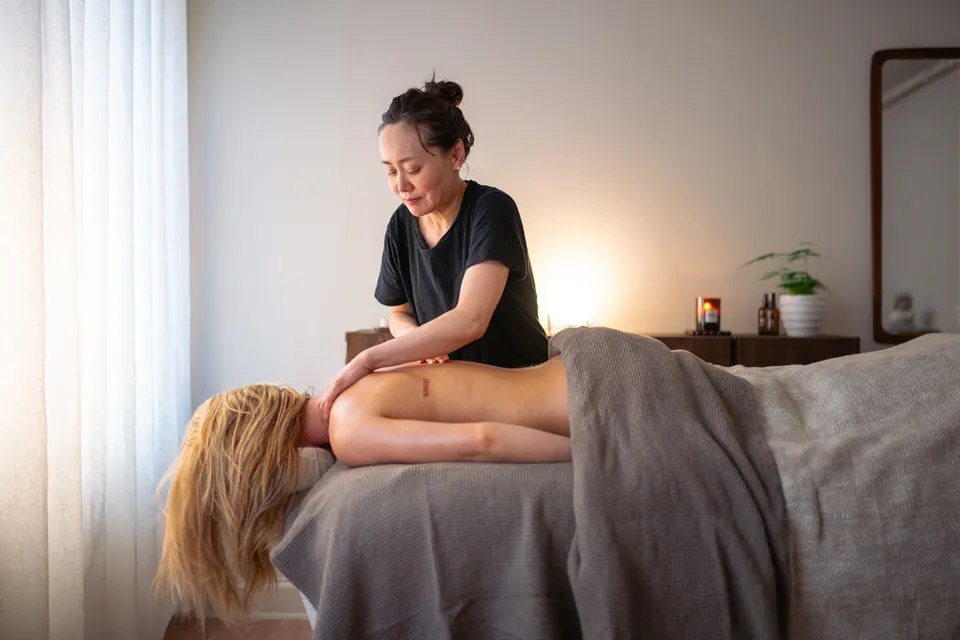
What are muscle knots?
Muscle knots is an everyday description of tender, tight areas in a muscle. You may hear the Danish word myoser when discussing these symptoms in Denmark. The area might feel like a small firm spot, a tight band or a broader patch that never quite relaxes.
It is a description rather than a complete explanation of the cause. There is no literal knot for a therapist to untie. A useful appointment starts with where you feel the tension, when it gets in the way and what you would like to find easier afterwards.
You do not need the right anatomical terms to book. Tell us if turning your head feels awkward, your back tires at your desk or a shoulder feels heavy after training. These details provide a much better starting point than choosing a treatment because its name sounds powerful.
Source: [1]
Where do you feel the tension?
Muscle knots in the neck
You might notice tenderness across the tops of your shoulders or near the base of your skull. Turning to look behind you on a bicycle or using a laptop may bring it to your attention. Some people also experience headaches. Our separate tension headache guide explores that subject in more detail.
Muscle knots in the back
A sore area between the shoulder blades is different from tiredness in the lower back. Show us the spot, and describe which movements bring it on. You and your practitioner agree on pressure and areas of focus.
What about trigger points?
A trigger point is a sensitive area where pressure can reproduce pain locally or elsewhere. Not every tender spot is a trigger point. Finding a lumpy area with your fingers does not, by itself, establish a diagnosis or tell you how it should be treated.

The trapezius is highlighted in red. This is an anatomical illustration, not a map of pain points or a diagnosis of your symptoms.
View a larger illustration
Why does the tightness keep returning?
Repeated loading, few breaks and long periods using the same muscles can all contribute. You do not have to sit at one particular wrong angle to become uncomfortable. Even a position you initially enjoy becomes repetitive if you rarely move out of it.
Look at the pattern across your week. Does the tightness follow long meetings, a particular lifting task or a demanding training session? Do you hold your breath or lift your shoulders when concentrating? This is useful information for choosing a practical change rather than blaming your body for failing to stay relaxed.
Massage provides welcome relief, while changing the repeated load gives that relief a better place in your routine. Alternating tasks, allowing recovery and adding short movement breaks can be more realistic than trying to redesign your entire working day overnight.
Source: [1]
Does massage help with muscle knots?
Massage helps many people feel less tender and more comfortable in a tight area. That is a worthwhile goal: lowering your shoulders, sitting more easily or moving with less effort. We assess the response through what you feel and can do, rather than how firmly a sore spot has been pressed.
A trial involving 228 people found short-term improvement with some massage schedules for chronic neck pain. A later Cochrane review found little or no difference from placebo around 12 weeks. Massage is an option for relief; a permanent resolution of every neck problem has not been demonstrated.
The work can include the sore area and relevant surrounding regions. You should not have to brace your whole body to tolerate it. A measured pace and continuing feedback leave room for focused contact without turning the session into a test of pain tolerance.
Sports massage or deep tissue?
Sports massage: a focus linked to activity
Sports massage is a useful choice when your priorities relate to running, cycling, strength training or physically demanding work. You and your practitioner agree on pressure and areas of focus. You do not need to compete or train at a particular standard.
Deep tissue: slower, concentrated work
Choose deep tissue if you prefer a more concentrated session around one or a few areas. The pace is slower and pressure builds gradually. You and your practitioner agree on pressure and areas of focus. Deeper work does not mean the strongest possible pressure throughout the appointment.
When rest matters most
If you feel both tired and tense, a relaxing body massage may suit you better than choosing the most intensive option. You can still ask for attention to your neck or back. The treatment name should help you select an experience, rather than make you feel you ought to endure something.
Your appointment at our Frederiksberg clinic
At Manual Therapies on Falkoner Allé 104, your visit starts with a conversation about your priorities, previous experiences and preferred pressure. You then agree a comfortable position and a manageable area to focus on.
A shorter session works well for a clearly defined focus. More time allows additional areas and an unhurried transition between them. Current durations and prices are shown on the treatment pages and in booking, so you can make the choice before confirming your appointment.
At the end, compare something specific with your starting point: turning your head, raising your arm or standing up. It is easier to follow one meaningful change than to expect your entire body to feel new. At a return visit, tell us how things felt during the days afterwards as well.
What can you do between appointments?
Change tasks and positions rather than searching for one perfect way to sit. Get up, take a short walk or move your shoulders when there is a natural break in your work. Use movements you can perform comfortably instead of forcing a stretch into pain.
Regular activity and strengthening are important in managing recurring neck discomfort. A physiotherapist can help tailor exercises and progression if you need an individual programme. Massage and movement can sit within the same plan rather than competing for your attention.
Avoid turning every tender spot into a long session with a hard ball or a massage tool. Brief, comfortable self-massage is different from repeatedly pressing an area that becomes increasingly irritated. A useful routine should help you get on with the day, not keep you checking the same spot.
Source: [2]
What should you notice after a massage?
Take a moment before rushing to your next task. Perhaps your shoulder feels easier to lower or your back feels less guarded. Sometimes the most welcome change is that your body feels calmer and the tense area no longer occupies so much of your attention.
You do not need to prove the result with a demanding workout immediately afterwards. You and your practitioner agree on pressure and areas of focus. Decide on follow-up from your needs and response instead of committing to a long course before trying the first session.
When should the pain be assessed first?
Seek medical advice for severe new pain, symptoms after an accident, fever, or increasing pain with numbness or weakness in an arm. Persistent symptoms that do not settle with ordinary activity and breaks also deserve assessment. New swelling or an unexplained lump should not be treated as a muscle knot.
Tell us about medication, recent operations, skin problems and conditions relevant to massage. That allows the appointment to be planned properly and avoids leaving you to guess which details matter while the treatment is already under way.
Source: [2]
Neck pain after a day at a screen
Start with a concrete example when describing neck pain. Is it difficult to turn your head while cycling home, do your shoulders tire during meetings, or do you mainly notice tightness once the day is over? That gives us more useful information than simply asking for every knot to be removed.
A focused massage can give one area plenty of attention, but the way your working day is arranged is worth considering too. Change between tasks and positions, rather than making a break depend on answering the final message. We can discuss what you have noticed without blaming every symptom on one posture.
If you mainly want a shorter visit centred on the head and neck, read our guide to scalp massage and Hovedro. Sports massage, deep tissue massage and body cupping are temporarily unavailable.
Neck pain and headaches: choose according to what you feel
Tense neck muscles and headaches can occur together, as Danish health guidance describes. That does not make every headache a muscular problem. Tell us if the headache has changed or your neck feels different from usual.
Our article on tension headaches focuses on the headache itself. This muscle-knot guide focuses on muscles, tight areas and choosing massage. The two articles complement each other, so you do not have to select a treatment from a symptom name alone.
Sports massage, deep tissue massage and body cupping are temporarily unavailable. If you want to understand how suction differs from pressure with the hands, explore our cupping massage guide. Choose according to your situation and sensitivity, rather than how intense a treatment looks in a video.
Source: [6]
Movement and small changes between appointments
For recurring muscular neck discomfort, Danish guidance highlights exercise and activity. Get help choosing an appropriate level if you are unsure, and seek assessment for worsening symptoms or symptoms travelling into the arm. A massage should not mean putting all ordinary movement on hold.
Choose something that fits your day: a short movement break between meetings, a walk or an agreed exercise programme. You do not need to introduce many new things at once. One change you actually repeat is easier to assess than a long list completed only once.
If you mainly want warmth and a longer, gentle pause, read our Hot Stone Massage guide. It also explains the difference between a warming session and focused work with loaded muscles, helping you choose according to the purpose of the visit.
Source: [6]
Muscle knots: questions and answers
Are myoser and muscle knots the same thing?
Myoser is a common Danish term for tender muscular tension, similar to the everyday English expression muscle knots. Explain where and when you feel it; you do not need a precise label to start the conversation.
Can one massage get rid of a knot?
One session can bring relief. How long it lasts depends on factors including your workload and the cause of the discomfort. Compare comfort and movement afterwards, then use that response to decide on follow-up.
Does massage have to hurt to work?
No. Focused contact and suitable pressure matter more than pressing as hard as possible. You and your practitioner agree on pressure and areas of focus.
Should I book sports massage or deep tissue?
Choose sports massage for a focus linked to activity and training load. Deep tissue suits slower, concentrated work around selected areas. Contact us if you would like help deciding between the two.
Can I add hot stones or cupping?
Hot stones are available as a 15-minute addition to selected body treatments.
How often should I book a massage?
There is no single schedule for everyone. Start with an appointment, notice your response and discuss whether follow-up would be useful. The interval should fit your priorities and everyday life.
Where is the clinic in Copenhagen?
Manual Therapies is at Falkoner Allé 104, 2000 Frederiksberg, Copenhagen. Sports massage, deep tissue massage and body cupping are temporarily unavailable.
Should I choose Hovedro or deep tissue for my neck?
Hovedro is a shorter appointment focused on the head, neck and shoulders. Deep tissue offers more precise hands-on work with selected tight areas and comes in several durations. Choose according to the work and time you want.
Should I stop moving my neck between massages?
Not as a general rule. Ordinary activity and suitable exercise can be part of your approach. Follow individual advice if you have an injury or are receiving treatment, and have new or worsening symptoms assessed.
Can cupping be an alternative to hands-on massage?
You and your practitioner agree on pressure and areas of focus. Read the guide and treatment contraindications, and tell us about medication or easy bruising before the appointment.
Sources and scope
These sources cover anatomy, studied methods and practical care. Details of our treatments and options come from the current clinic catalogue.
- Sundhed.dk: Nakken, muskelsmerter
- Sundhed.dk: Nakkesmerter
- Cleveland Clinic: Myofascial Pain Syndrome
- Sherman et al. (2014): Five-week outcomes from a dosing trial of therapeutic massage for chronic neck pain
- Gross et al., Cochrane (2024): Massage for neck pain
- Sundhed.dk: Nakken, muskelsmerter — activity and muscle-related neck pain
First published: 27 October 2026. Text rewritten and updated: 28 October 2026.


